

2.030 Obtaining Authority To Dismantle a Vehicle (VC §11520)
A licensed dismantler must submit the Report of Vehicle To Be Dismantled (REG 42) to the department together with the required clearance documents within 90 days of acquiring a vehicle. After the department has approved the application, the duplicate copy of the REG 42 will be validated and returned to the dismantler. If the application is incomplete and returned to you, authorization has not been granted by the DMV.
2.020 Notice of Acquisition/Report of Vehicle To Be Dismantled Exceptions (VC §§11520 [b], 22664)
The chart below explains when a Notice of Acquisition (REG 42) and a Report of Vehicle To Be Dismantled (REG 42) must be completed.
| Application Type | Notice of Acquisition | Report of Vehicle to be Dismantled |
|---|---|---|
| Application TypeSalvage vehicles acquired on a Salvage Certificate (REG 489) (VC §11515[a]). | Notice of Acquisitionnot required | Report of Vehicle to be Dismantledrequired |
| Application TypeNonrepairable vehicles acquired on a Nonrepairable Vehicle Certificate (REG 490) (VC §11515.2). | Notice of Acquisitionnot required | Report of Vehicle to be Dismantledrequired |
| Application TypeAbandoned vehicles and vehicles removed for reasons other than abandonment acquired on a Public Agency Authorization To Dispose of Vehicle to a Scrap Iron Processor or Dismantler Valued at $500 or Less (REG 462) (VC §§22851.2, 22851.3[j]). | Notice of Acquisitionnot required | Report of Vehicle to be Dismantledrequired |
| Application TypeAbated vehicles acquired from a city or county under a local abatement program for which the city or county submitted a Notice—Removal of Abandoned Vehicle (REG 104) to the department (VC §§ 22660 & 22664). | Notice of Acquisitionnot required | Report of Vehicle to be Dismantlednot required |
| Application TypeVehicles acquired with lien sale documents as the titling documents. (CC §§3071 & 3072). | Notice of Acquisitionnot required | Report of Vehicle to be Dismantledrequired |
| Application TypeVehicles for which the DMV database has already been updated with “junk” status. | Notice of Acquisitionnot required | Report of Vehicle to be Dismantlednot required |
| Application TypeAll others | Notice of Acquisitionrequired | Report of Vehicle to be Dismantledrequired |
2.010 Report of Vehicle To Be Dismantled and Dismantlers Notice of Acquisition (REG 42)
Whenever a Dismantlers Notice of Acquisition (REG 42) is mailed, the corresponding Report of Vehicle To Be Dismantled (REG 42) must be completed and accompany the paperwork when the documents are sent to the department to record the vehicle’s dismantled status.
Note There may be some cases where a Dismantlers Notice of Acquisition is not required, but the Report of Vehicle to be Dismantled is required. Refer to the chart in Section 2.020.
Acquiring and Dismantling Vehicles
Chapter 2 Acquiring and Dismantling Vehicles
2.000 Procedure When a Vehicle Is Acquired (VC §§11520, 22664)
Step 1
Before accepting the vehicle, check the vehicle identification number on all documents with the vehicle identification number on the vehicle. If the documents do not match the vehicle, the owner must provide correct documents before you take it into your inventory.
Step 2
Complete the Dismantlers Notice of Acquisition (REG 42) in triplicate. For a list of transactions that do not require the Dismantlers Notice of Acquisition, refer to the chart in Section 2.020. For instructions on completing the REG 42, refer to Chapter 3.
Step 3
Mail the Notice of Acquisition (REG 42) to the DMV (original) and Department of Justice (duplicate) within five calendar days of acquiring the vehicle, not counting the day of acquisition. Calendar days include Saturday, Sunday, and state holidays. The postmark date on the envelope will determine compliance. See Section 3.010.
Dismantler’s License
Chapter 1 Dismantler’s License
1.000 Dismantler Defined (VC §220)
A dismantler is one who:
- Buys, sells, or deals in vehicles subject to California registration, including nonrepairable vehicles, for the purpose of dismantling them.
- Buys or sells the integral parts and component materials of vehicles, in whole or in part.
- Deals in used motor vehicle parts.
Copyright
© Copyright, Department of Motor Vehicles 2025
All rights reserved.
This publication is licensed under the Creative Commons Attribution-NonCommercial 4.0 International License (CC BY-NC 4.0). You are free to copy, distribute, and adapt the material for non-commercial educational purposes, as long as you give appropriate credit to the California Department of Motor Vehicles. Commercial use is prohibited without prior written permission.
Attribution should be provided as follows: “California Driver’s Handbook, California Department of Motor Vehicles, licensed under CC BY-NC 4.0.“
Section 7: Laws and Rules of the Road (Continued)
Sharing the Road
Drivers need to share the road with other vehicles, pedestrians, bicyclists, road workers, and large vehicles.
Blind Spots (the No Zone)
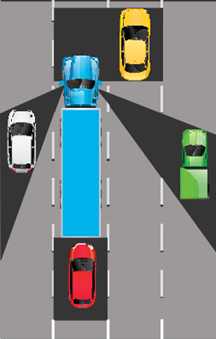
Large vehicle and truck drivers have a better view in front of them and bigger mirrors. But they also have large blind spots, also called No Zones. In these areas, your vehicle can disappear from a large vehicle or truck driver’s view. If you cannot see the truck’s side mirrors, the truck driver cannot see you.
Braking
Large vehicles and commercial trucks take longer to stop than passenger vehicles traveling at the same speed. When traveling, they create extra space in front of their vehicle to use if they need to stop suddenly. The average passenger vehicle traveling at 55 mph can stop within 300 feet. A large vehicle traveling at the same speed can take up to 400 feet to stop. The heavier the vehicle and the faster it is moving, the longer it takes to safely stop, so a loaded truck will take longer to stop than an empty truck. Do not move in front of a large vehicle and suddenly slow down or stop. The large vehicle will not be able to stop fast enough to avoid crashing into you.
Turning
When a vehicle turns, the rear wheels follow a shorter path than the front wheels. The longer the vehicle, the greater the difference in the length of the turning path. This is why large vehicles and truck drivers must often swing wide to complete a turn. When you follow a large vehicle, look at its turn signals before you start to pass. It may appear to be turning one direction but instead is swinging wide in the opposite direction in order to turn.
Maneuvering
Large vehicles and trucks are not as easy to maneuver as passenger vehicles. On a divided highway with four or more traffic lanes in one direction, they may be driven in the two lanes farthest to the right. When driving near large vehicles and trucks, do not:
- Change lanes directly in front of them to reach an exit or turn.
- Drive next to them longer than you need to. Always pass a large vehicle on the left side. After you pass the large vehicle or truck, move ahead of it. Driving alongside a large vehicle makes it hard for the driver to avoid dangers in the road.
- Follow too closely. Tailgating decreases a vehicle’s safety distance.
- Underestimate their size and speed as they often appear to be traveling slower.
Buses, Streetcars, Trolleys
Safety zones are spaces set aside for pedestrians waiting for buses, streetcars, and trolleys. Safety zones are marked by raised buttons or markers on a road. Do not drive through a safety zone under any condition.
When a bus, streetcar, or trolley is stopped at a safety zone or traffic light, you may pass at no more than 10 mph.
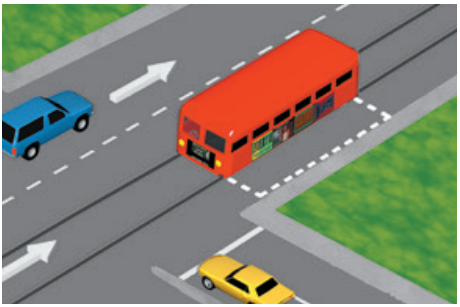
Do not overtake and pass a light rail vehicle or streetcar on the left side, whether it is moving or standing, unless:
- When the tracks are so close to the right side that the passenger vehicle cannot pass on the right.
- You are on a one-way street.
- A traffic officer directs you to pass on the left.
Light Rail Vehicles
On public roads, light rail vehicles have the same rights and responsibilities as other vehicles. To safely share the road with light rail vehicles:
- Be aware of where they operate. Buildings, trees, and other items can cause blind spots for the operator.
- Never turn in front of an approaching light rail vehicle.
- Maintain a safe distance.
- Check for approaching light rail vehicles before you turn across the tracks. Complete your turn only when the traffic light indicates you may proceed. Be aware they can interrupt traffic lights.

Motorcycles
Motorcyclists have the same rights and responsibilities as other vehicle drivers. To safely share the road with motorcyclists:
- Check for motorcycles and use your mirrors when you change lanes or enter a road. Motorcycles are smaller in size and harder to see so they easily disappear in vehicle blind spots.
- Allow a safe three-second following distance. This space will help you avoid hitting a motorcyclist if they brake suddenly or fall.
- Whenever possible, give a motorcycle the full lane. It is legal to share lanes with motorcycles, this is known as lane splitting.
- Never try to pass a motorcycle in the same lane as you.
- Check for motorcyclists before you open your door next to traffic.
- When possible, move to one side of your lane to give motorcyclists more room to pass.
Road conditions can cause motorcyclists to suddenly change speed or direction.
Emergency Vehicles
Give the right-of-way to any law enforcement vehicle, fire engine, ambulance, or other emergency vehicle using a siren and red lights. Failure to pull over may result in a ticket. Drive to the right edge of the road and stop until the emergency vehicle(s) have passed.
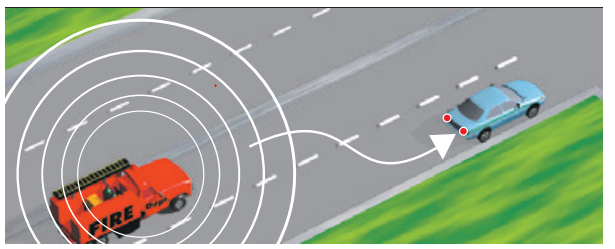
When approaching a stationary emergency vehicle with flashing emergency signal lights (hazard lights), move over and slow down.
If you are in an intersection when you see an emergency vehicle, continue through the intersection. Drive to the right as soon as it is safe and stop.
Obey any direction, order, or signal given by a law enforcement officer, or firefighter. Follow their orders even if they conflict with existing signs, signals, or laws.
It is against the law to follow within 300 feet of any fire engine, law enforcement vehicle, ambulance, or other emergency vehicle when their siren or flashing lights are on.
You can be arrested if you drive to the scene of a fire, collision, or other disaster. When you do this, you are getting in the way of firefighters, ambulance crews, or other rescue and emergency personnel.
Slow-moving Vehicles
They can take longer to get up to speed when entering traffic. Large trucks, bicycles, and some cars lose speed on long or steep hills. Some slow-moving vehicles have an orange and red triangle on their back, such as road maintenance vehicles, which usually travel at 25 mph or less.
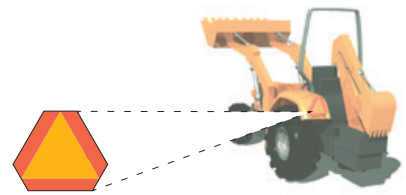
Other types of slow-moving motorized vehicles that may operate on public roads include:
- Scooters
- Neighborhood electric vehicles
- Golf carts
Adjust your speed to share the road with these vehicles.
Neighborhood Electric Vehicles (NEV) and Low-speed Vehicles (LSV)
Watch for slow-moving vehicles when you see these signs or markings:
- NEV USE ONLY
- NEV ROUTE
NEVs and LSVs reach a maximum speed of 25 mph. They are restricted from roads where the speed limit is greater than 35 mph.
Animal-drawn Vehicles
Horse-drawn vehicles and people riding horses or other animals are allowed to share the road with motor vehicles. It is against the law to intentionally scare horses or livestock.
Near Animals
If you see a sign with a picture of an animal, watch for animals on or near the road. If you see animals or livestock near the road, slow down or stop and proceed when it is safe. Be sure to follow directions from the person in charge of the animals.
Bicycles
Bicyclists have the same rights and responsibilities as other drivers.
Bicyclists may:
- Legally ride on certain sections of freeways where there is no alternate route and bicycling is not forbidden by law.
- Move left to avoid hazards. These may include parked or moving vehicles, bicycles, animals, or trash.
- Choose to ride near the left curb or edge of a one-way street.
- Choose to use crosswalks by stopping and crossing as a pedestrian.
Bicyclist Responsibilities
As a bicyclist, you must:
- Obey all traffic signs, signal lights, and basic right-of-way rules.
- Ride in the same direction as traffic.
- Always look over your shoulder to make sure the lane is clear before turning or changing lanes.
- Yield to pedestrians.
- Wear a helmet (if under 18 years old).
- Stay visible (for example, never weave between parked vehicles).
- Ride as near to the right curb or edge of the roadway as possible.
- Not ride on the sidewalk (unless allowed by the city).
- Make left and right turns in the same way drivers do, using hand signals and turn lanes.
- Use a bike lane, whenever possible, or use a through traffic lane.
- Have fully functional brakes.
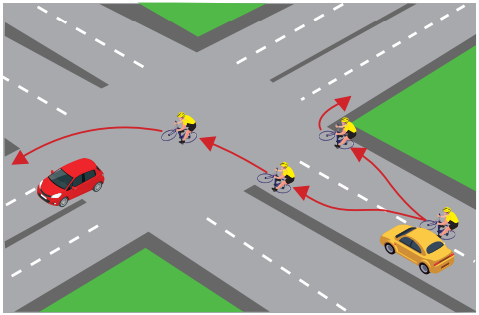
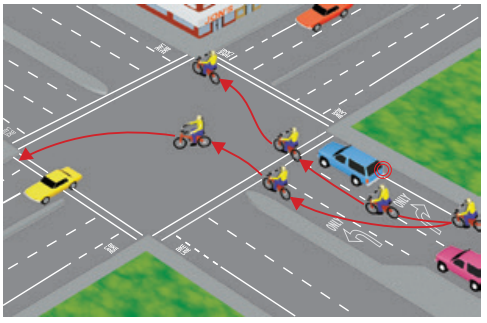
Bicycling at Night
When it is dark out, bicyclists should avoid wearing dark clothing. Your bicycle must have the following equipment:
- A front lamp with a white light visible from 300 feet.
- A built-in rear red reflector, solid red light, or flashing red light. This must be visible from 500 feet.
- A white or yellow reflector on each pedal, the bicyclist’s shoes, or their ankles. These must be visible from 200 feet.
- A white or yellow reflector on the front wheel, a white or red reflector on the rear wheel, or reflectorized tires.
Bicycling in Travel Lanes
Bicyclists traveling slower than the flow of traffic must ride as close as possible to the right curb or edge of the road, unless:
- Passing a vehicle or another bicycle in the same direction.
- Preparing to make a left turn.
- Avoiding a hazard or road condition.
- A lane is too narrow for a bicycle and a vehicle to safely travel side-by-side in the lane.
- Approaching a right turn.
- On a one-way road with two or more lanes. In this case, a bicyclist may ride near the left curb or edge of the road.
Drivers should follow at a safe distance. When it is safe, the bicyclist should move to a position that allows vehicles to pass.
Passing a Bicyclist
To safely pass a bicyclist that is in the travel lane, you may need to change to another lane. In this case, pass safely, then return to your original lane. Leave space between your vehicle and the bicyclist.
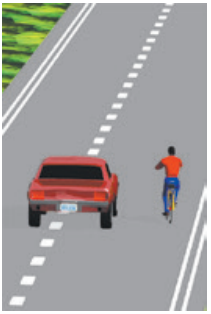
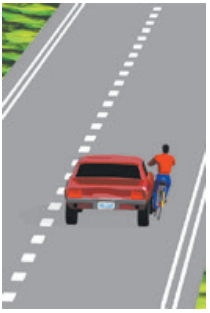
When you cannot change lanes to pass a bicyclist, allow at least three feet between your vehicle and the bicyclist. If you cannot give three feet of space, do not pass the cyclist until three feet of clearance can be given. This will help you avoid putting the bicyclist in danger. Remember to:
- Give bicyclists enough space so they are not forced into parked vehicles or open vehicle doors.
- Only merge toward the curb or into the bike lane when it is safe.
- Merge safely behind a bicyclist when preparing to make a turn.
- Enter a bike lane no more than 200 feet before starting a turn.
- Check for bicyclists when changing lanes or entering traffic. They may be hidden in a vehicle’s blind spots.
- Be careful when approaching or passing a bicyclist on a two-lane road.
Road Workers and Work Zones
You will see warning signs and message boards when there are workers, slow-moving equipment, and closed lanes ahead.
Go through the work zone carefully by:
- Slowing down.
- Allowing extra space between vehicles.
- Expecting sudden slowing or stopping.
- Watching for drivers changing lanes.
- Avoiding distractions.
Cones, drums, or other barriers will guide you through the work zone. Prepare to slow down or stop for highway equipment. Merge as soon as it is safe without crossing the cones or drums. Watch for bicycles if lanes are narrow or the shoulder is closed. Obey special signs or instructions from workers such as flaggers.
Fines and Double Fine Zones
Fines for traffic violations in a work zone can be $1,000 or more. Anyone convicted of assaulting a highway worker faces fines of up to $2,000 and imprisonment for up to one year.
Certain roads are chosen as Safety Enhanced-Double Fine Zones. This is due to increased collision-related injuries and fatalities. Fines are doubled in these zones.
Fines are also doubled in highway construction or maintenance zones when workers are present.
Move Over and Slow Down
Drivers must move over and slow down for emergency and road work vehicles. These include:
- Stationary emergency vehicles or tow trucks displaying flashing amber warning lights.
- Stopped road work vehicles displaying emergency flashing or amber warning lights.
Vehicles with Hazardous Loads
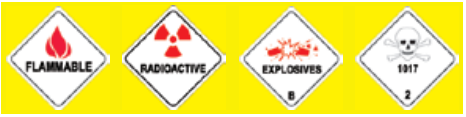
A diamond-shaped sign on a truck means that the truck’s load may be dangerous (gas, explosives, etc.). Vehicles with these signs must stop before crossing railroad tracks.
Heavy Traffic or Bad Weather
You must drive slower when there is heavy traffic or bad weather. At the same time, you should not block normal and reasonable traffic flow by driving too slowly. If you drive faster or slower than the speed limit, you may be cited. When another driver is close behind you and wishes to drive faster, move to the right. If you choose to drive slower than other traffic, drive in the right lane. Refer to Choosing a Lane in Section 6 for more information.
Towing
You must drive in the far-right lane or a lane marked for slower vehicles when you:
- Tow a vehicle or trailer.
- Drive a truck with three or more axles.
If no lanes are marked and there are four or more lanes in your direction, you may only drive in the two lanes closest to the right edge of the road.
Around Children
The speed limit is 25 mph within 500 feet of a school while children are outside or crossing the street. Some school zones may have speed limits as low as 15 mph. When near schools, look for:
- Bicyclists and pedestrians.
- School safety patrols or crossing guards. Be sure to obey their directions at all times.
- Stopped school buses and children crossing the street.
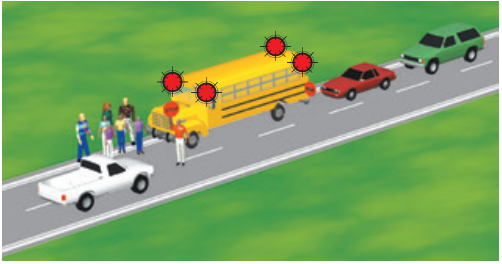
- Some school buses flash yellow lights when preparing to stop to let children off the bus. The yellow flashing lights warn you to slow down and prepare to stop.
- When the bus flashes red lights (located at the top, front, and back of the bus), you must stop from either direction until the children are safely across the street and the lights stop flashing. Remain stopped while the red lights are flashing. If you fail to stop, you may be fined up to $1,000 and your driving privilege could be suspended for one year.
- If the school bus is on the other side of a divided or multilane highway (two or more lanes in each direction), you do not need to stop.
Blind Intersections
An intersection is considered blind if it has no stop signs at any corner.
If your view is blocked, move slowly forward until you can see. The speed limit for a blind intersection is 15 mph.
Alleys
An alley is any road no wider than 25 feet that is used to access the rear or side entrances of buildings or properties. You may drive on or cross a sidewalk to enter or exit a driveway or alley. The speed limit in an alley is 15 mph.
Near Railroad or Light Rail Tracks
The speed limit is 15 mph within 100 feet of a railroad crossing and you cannot see the tracks for 400 feet in both directions. You may drive faster than 15 mph if the crossing is controlled by gates, a warning signal, or a flagman. At railroad or train crossings:
- Flashing red warning lights indicate you must stop and wait. Do not proceed over the railroad tracks until the red lights stop flashing, even if the gate rises.
- When the crossing devices or a person warns you a train is coming, stop at least 15 feet from the nearest track.
- Do not go under lowering gates or around lowered gates. If the gates are lowered and you do not see a train approaching, call the posted railroad emergency toll-free number or 911.
- Stop, look, and listen. If you see a train coming or hear a horn or bell, do not cross. Many crossings have multiple tracks. Look in both directions and only cross when it is safe.
- Expect a train on any track, at any time, traveling in either direction.
- Never stop on the railroad tracks. Wait and do not begin proceeding if you do not have enough room to completely cross the tracks. If you are on the tracks, you risk injury or death.
- Watch for vehicles that must stop before they cross train tracks. These vehicles include buses, school buses, and vehicles marked with a hazardous materials placard.
Business or Residential Districts
The speed limit is 25 mph, unless otherwise posted.
Section 9: Alcohol and Drugs
California’s driving under the influence (DUI) laws apply to both alcohol and drugs. It is illegal to drive while under the influence of alcohol or any drug that affects your ability to drive safely. As you age, your tolerance to alcohol decreases, which increases the risk of alcohol-related driving problems. The law does not see a difference between illegal drugs and medications you get from a doctor or pharmacy. They can all affect your ability to drive safely and react to what you see and hear.
No matter what age you are, it is illegal to drive after:
- Drinking excessive amounts of alcohol in any form. This includes medications like cough syrup.
- Taking any drug that affects your ability to drive. This includes prescriptions or over-the-counter medications.
- Using any combination of alcohol or drugs that decreases your ability to drive safely.
Make sure you read medication labels and know the effects of any drug you use. If a law enforcement officer thinks you are driving while under the influence of drugs or alcohol, they have the right to ask you to take a blood or urine test. If you refuse to take one, DMV will suspend or revoke your driving privilege for one year.
Important If you are 13 to 20 years old and convicted of operating a bicycle while under the influence of alcohol or drugs, your driving privilege may be suspended or delayed for one year once you are eligible to drive.
Use or Possession of Alcohol or Cannabis Products in a Vehicle
The law is very strict about carrying alcohol or cannabis products in your vehicle with you. It is illegal to drink any alcohol, to smoke or eat a cannabis product while you are driving or riding as a passenger in a vehicle. If you are carrying any alcohol or cannabis in your vehicle, the container must be sealed and unopened. If it is open, you must keep the container in the trunk or place where passengers do not sit. It is also illegal to keep an open container of alcohol in your glove box. This law does not apply if you are a passenger in a bus, taxi, camper, or motorhome.
Blood Alcohol Concentration (BAC) Limits
When you consume alcohol, traces of it enter your bloodstream. Your BAC measures how much alcohol is present in your bloodstream.
It is illegal for you to drive if you have a BAC of:
- 0.08% or higher if you are over 21 years old.
- 0.01% or higher if you are under 21 years old.
- 0.01% or higher at any age if you are on DUI probation.
- 0.04% or higher if you drive a vehicle that requires a commercial driver’s license.
- 0.04% or higher if you are driving a passenger for hire.
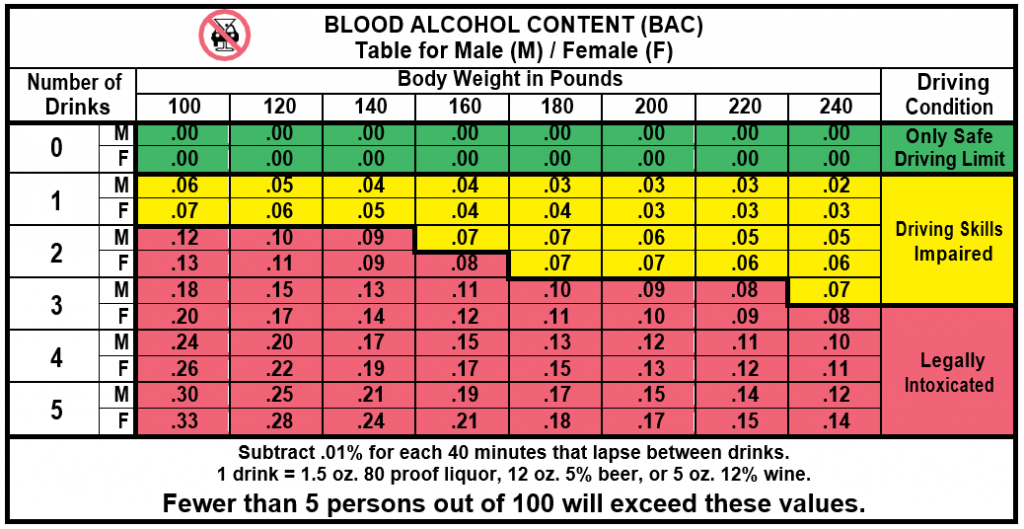
If you drive with an illegal BAC, a law enforcement officer can charge you with DUI. Even if your BAC is below legal limits, that does not mean it is safe for you to drive. Almost everyone feels negative effects of alcohol, even at levels lower than the legal limit. Depending on how badly you are impaired, you may be arrested and convicted of a DUI even without a BAC measurement.
The table below shows BAC estimates based on how many drinks are consumed, gender, and body weight. Remember, even one drink can affect your ability to drive safely.
Note It is illegal to drink alcohol or take drugs when you are operating a boat, jet ski, water skis, aquaplane, or similar vessels. Learn more in the California Harbors and Navigation Code.
DUI Arrests
When you drive in California, you consent to a breath, blood, or urine test if a law enforcement officer suspects you of DUI. If you agreed to take a preliminary alcohol screening (PAS) or breath test, you may still be required to take a blood or urine test to detect the presence of drugs. If you refuse, DMV will suspend or revoke your driving privilege. If you are arrested for DUI:
- California’s Administrative Per Se law requires DMV to suspend your driving privilege.
- The law enforcement officer may take your driver’s license and give you a temporary driver’s license for 30 days.
- You may request a DMV administrative hearing within 10 days from the date of your arrest.
DUI Convictions
If you are convicted of a DUI, DMV will suspend or revoke your driving privilege and you:
- Must complete a DUI program.
- Must file a California Insurance Proof Certificate (SR 22/SR 1P).
- Must pay any applicable license reissue or restriction fees.
- May be required to install an ignition interlock device (IID) on your vehicle.
Here are some additional penalties if you are convicted of DUI:
- You may be sentenced to up to six months in jail.
- You may have to pay a fine.
- Law enforcement may impound your vehicle and you may have to pay a storage fee.
- If you cause serious injury or death while driving under the influence of drugs or alcohol, you may face civil lawsuits.
All DUI convictions remain on your driver’s record for 10 years. If you get any other DUIs during that time, the court or DMV may give you an additional penalty.
Drivers Under 21
If you are under 21 years old, there are additional laws for possessing and consuming alcohol.
Possessing alcohol:
- You may not carry any alcohol beverage inside a vehicle unless an individual who is 21 years old or older is with you. The container must be full, sealed, and unopened. If opened, the alcohol must be kept in the trunk or place where passengers do not sit.
Exception: If you are working for someone with an off-site liquor sales license, you may carry alcoholic beverages in closed containers. - If you are caught with alcohol in your vehicle, law enforcement can impound your vehicle for up to 30 days. The court may fine you and suspend your driver’s license for one year. If you do not already have a driver’s license, the court may ask DMV to delay giving you your first driver’s license for up to one year.
Consuming alcohol:
- If a law enforcement officer suspects you of consuming alcohol, they can require you to take a hand-held breath test, PAS, or another chemical test.
- If you are convicted of a DUI with a BAC of 0.01% or higher, DMV may revoke your driving privilege for one year. You must also complete a licensed DUI program.
- If your PAS shows a BAC of 0.05% or higher, the officer may require you to take a breath or blood test.
- If a later test shows you have a BAC of 0.05% or higher, you may be arrested for a DUI and your driving privilege may be suspended.
Section 8: Safe Driving
Be Aware of Your Surroundings
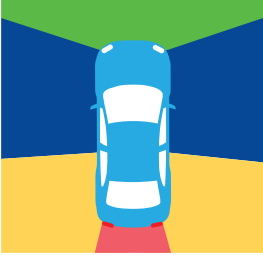
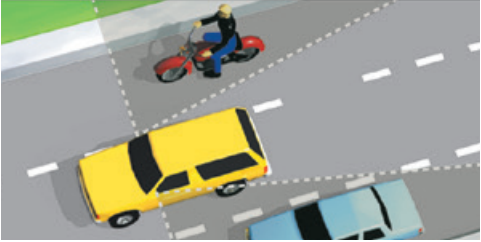
To drive safely, you need to know what is around you. This helps you make good decisions and react to hazards on the road. This image shows the areas around your vehicle.
- Green: Ahead of you.
- Blue: Next to you.
- Yellow: Blind spots.
- Red: Behind you.
Scan Your Surroundings
To give yourself time to react, avoid last minute moves and hazards, always keep your eyes moving and scan the road at least 10 seconds ahead of your vehicle.
Tailgating (Following Too Closely)
Tailgating makes it harder for you to see the road ahead because the vehicle in front of you blocks your view. You will not have enough time to react if the driver in front of you brakes suddenly. Use the three-second rule to ensure a safe following distance and avoid a collision. Following other vehicles at a safe distance gives you enough time to react if another driver makes a mistake.
If a vehicle merges in front of you too closely, take your foot off the accelerator. This creates space between you and the vehicle ahead.
Create more space in front of your vehicle when:
- A tailgater is behind you. Maintain your course and speed. Then, when safe to do so, merge right to change into another lane and allow the tailgater to pass.
- Following motorcyclists on metal surfaces (bridge gratings, railroad tracks, etc.), and gravel.
Know What is At Your Side
Be aware of what is on each side of you. To maintain enough space to
maneuver safely and react to other drivers:
- Do not stay in another driver’s blind spot.
- Avoid driving directly alongside other vehicles.
- Make space for vehicles entering freeways, even if you have the right-of-way. Be ready for rapid changes and watch for signals from other drivers.
- Keep space between your vehicle and parked vehicles.
- Look both ways, even at intersections where traffic has a red light or stop sign.
Blind Spots
Every vehicle has blind spots. These are areas around the vehicle that a driver cannot see when looking straight ahead or using the mirrors. For most vehicles, the blinds spots are at the sides, slightly behind the driver.
To check your blind spots, look over your right and left shoulders out of your side windows. Only turn your head when you look. Do not turn your whole body or steering wheel. Check your blind spots before you:
- Change lanes.
- Turn at an intersection.
- Merge with traffic.
- Back up.
- Leave a parking space.
- Parallel park.
- Pull out from the curb.
- Open your car door.
Know What is Behind You
Knowing what is behind you can help you avoid rear-end collisions. Check traffic behind you often by using your rearview mirror, side mirrors, and turning your head when you:
- Change lanes.
- Check your blind spots.
- Reduce your speed.
- Turn into a side road or driveway.
- Stop to pull into a parking space.
- Pull up to and away from the curb.
- Back up.
Understand the Road Conditions
Darkness
When driving at night, use your high-beam headlights on open country roads or dark city streets. Make sure you can stop in the distance lit by your headlights. Do not use high-beam headlights in areas where they are illegal. Dim your high-beam headlights to avoid blinding the driver of an oncoming vehicle. If another vehicle’s lights are too bright:
- Do not look directly into the oncoming headlights.
- Look toward the right edge of your lane.
- Watch the oncoming vehicle out of the corner of your eye.
- Do not react to the other driver by keeping your high-beam headlights on. This only makes it harder for both of you to see.
When it is raining, use your low-beam headlights. Do not drive using only your parking lights. When you drive at night, remember:
- Motorcycles, pedestrians, and bicyclists are much harder to see.
- Highway construction can take place at night. Reduce your speed in highway construction zones.
- When you leave a brightly lit place, drive slowly until your eyes adjust to the darkness.
- When a vehicle with one light drives toward you, drive as far to the right as possible. It could be a bicyclist, motorcyclist, or vehicle with a missing headlight.
Sun Glare
To help manage sun glare:
- Keep the inside and outside of your windshield clean.
- Wear polarized sunglasses.
- Maintain enough space between your vehicle and the vehicles around you.
- Make sure your car visor works and is free of anything that would restrict use.
- Be aware of pedestrians. You may have difficulty seeing them.
- Try to avoid driving during sunrise and sunset.
Skids
A skid is when one or more of the tires lose traction with the road and the vehicle starts to slip. You may not be able to control your vehicle. There are a few different types of skids.
Slippery Surface Skids
Ice and packed snow on the road can cause your vehicle to skid. This is even more likely if you are driving too fast or going downhill. Drive slowly and leave space between your vehicle and the vehicle ahead of you. To prevent skidding on slippery surfaces:
- Slow down as you approach intersections and curves. For sharp curves, slow down as you approach and move through.
- Avoid fast turns and quick stops.
- Shift to low gear before going down a steep hill.
- Avoid areas like ice patches, wet leaves, oil, or standing water.
If you start to skid, follow these steps:
- Slowly remove your foot from the accelerator
- Do not use the brakes.
- Turn the steering wheel in the direction of the skid.
- Try to get a wheel on dry pavement.
Locked Wheel Skids
A locked wheel skid is usually caused by braking too hard when you are going too fast. If this happens, your vehicle will skid no matter which way the steering wheel is turned. To get out of a locked wheel skid if your vehicle is equipped with:
- Four-wheel antilock braking system (ABS), apply firm pressure on the brake pedal.
- Rear-wheel ABS (common in light trucks):
- Ease up on the brake pedal while maintaining just enough pressure to allow the front wheels to roll again so you can steer.
- Stop braking and turn the steering wheel into the direction of the skid.
- Front-wheel ABS, remove your foot from the brake pedal to unlock the wheels. Steer in the direction you want to go and straighten the front wheels as the vehicle begins to straighten out.
Note To determine if your vehicle has ABS, refer to the vehicle owner’s manual.
If your vehicle is not equipped with ABS and begins to skid, quickly pump your brakes until you are at a safe speed. If you:
- Press the brake pedal and it sinks to the floor, quickly pump the brakes by gently applying and releasing pressure on your brake pedal.
- Pump the brakes, down shift your vehicle into a lower or neutral gear to slow down. Then try using your emergency brake to stop.
If your brakes get wet, you can dry them by lightly pressing the accelerator and brake pedals at the same time. Only do this until the brakes dry.
Slippery Roads
Rain, snow, or mud can make the roads slippery. Drive more slowly than you would on a dry road and allow for more space between your vehicle and the vehicle ahead of you.
Adjust your speed for different conditions:
- Wet road: Reduce your speed by 5 to 10 mph.
- Packed snow: Reduce your speed by half.
- Ice: Reduce your speed to no more than 5 mph.
Some road surfaces are more slippery than others when wet. These usually have warning signs posted. Here are situations where the road may be more slippery:
- Shade from trees or buildings can hide icy spots on cold, wet days. These areas freeze first and dry out last.
- Bridges and overpasses tend to freeze before the rest of the road. They can have icy spots.
- When it starts to rain, the pavement can be very slippery.
Slow down at the first sign of rain, drizzle, or snow on the road. This is especially true if it has been dry and hot for some time, because oil and dust on the road’s surface have not been washed away.
Turn on your windshield wipers, low-beam headlights, and defroster. In a heavy rainstorm or snowstorm, you may not be able to see more than 100 feet in front of your vehicle. If you cannot see farther than 100 feet, it is not safe to drive faster than 30 mph. You may have to stop from time to time to wipe mud or snow off your windshield, headlights, and taillights. If you drive in snowy areas, carry snow chains for your tires. Snow chains give your tires more traction. Carry the correct number and type of chains for your vehicle.
Hydroplaning
Hydroplaning occurs when driving in wet or rainy conditions. Hydroplaning is a vehicle riding on water because the tires lose all contact with the road. A slight change of direction, applying the brakes, or a gust of wind could throw the vehicle into a skid. To avoid hydroplaning:
- Drive slowly.
- Steer around standing water, if possible.
- Slow down if you hear sloshing sounds from the tires.
- Slow down when changing lanes or direction.
If your vehicle starts to hydroplane:
- Slow down gradually.
- Do not use the brakes. Sudden braking may cause you to lose control of your vehicle.
Stuck in Snow or Mud
If stuck in the snow or mud, follow these steps:
- Shift into a low gear and keep the front wheels straight.
- Gently step on the accelerator. Avoid spinning the wheels.
- Drive slowly forward as far as possible.
- Shift into reverse and slowly back up as far as possible. Do not spin the wheels.
- Shift into a low gear again and drive forward.
- Repeat a forward-backward motion until the vehicle rolls free.
- In deep mud or snow, put boards, tree branches, etc., under the tires. Only take this action when the vehicle is stopped.
Flooded Roads
Excessive water on a road may cause flooding. This can happen gradually or suddenly. It is important to understand the dangers of water on the road, including:
- Being swept off the road.
- Floating debris and unseen hazards.
- The road collapsing.
- Vehicle malfunction.
- Electrocution if there are fallen power lines.
It may not be possible to determine the depth of the flood by looking. If the water is deep, the road may be too dangerous to cross. It is best to find another route. If you have no other option but to drive through a flooded road, drive slowly. After you make it through the water, test your brakes to make sure they work correctly.
High Winds
High winds can be a hazard while driving. This is especially true for larger vehicles such as trucks, campers, and vehicles with trailers. When driving in high winds:
- Reduce your speed. This gives you better control over your vehicle. You will have more time to react if your vehicle gets hit by a strong gust of wind.
- Maintain a firm hand position on the steering wheel. Strong wind gusts are unpredictable. If you are not holding the wheel properly and a gust hits, you can lose control of the vehicle.
- Be alert. Look ahead and watch for any debris on the road. Give yourself enough time to react to road hazards.
- Do not use cruise control. Maintain maximum control of the accelerator if a gust occurs.
- Be proactive. It may be safer to pull over and wait for the storm to pass.
Fog or Heavy Smoke
It is best to avoid driving in heavy fog or smoke. Consider postponing your trip until the fog clears. If you must drive in heavy fog or smoke:
- Drive slowly.
- Use your low-beam headlights. High-beam headlights will reflect back and cause glare.
- Never drive using only your parking or fog lights.
- Make sure you can stop within the space you can see ahead.
- Increase your following distance.
- Use your windshield wipers and defroster as necessary.
- Avoid crossing lanes or passing traffic unless absolutely necessary.
- Listen for traffic you cannot see.
If the fog becomes too thick to drive safely, consider pulling off the road. Activate your emergency flashers and wait for conditions to improve.
Law Enforcement Traffic Breaks
During a traffic break, the officer turns on their emergency lights and slowly weaves across lanes. Law enforcement uses traffic breaks to:
- Slow or stop traffic to remove hazards from the road.
- Slow or stop traffic during heavy fog or unusual traffic conditions.
- Prevent collisions during unusual conditions.
You should:
- Turn on your emergency flashers to warn other drivers.
- Slowly decrease your speed to the same speed as the officer. Do not brake suddenly unless necessary to avoid a collision. Keep a safe distance from the patrol vehicle ahead of you.
- Not drive past the patrol vehicle. Do not speed up until the officer turns off their emergency lights and traffic conditions allow you to return to your normal speed.
Section 6: Navigating the Roads (Continued)
Parking
Parallel Parking
Parallel parking is when you park in line with the road and other parked vehicles. To parallel park:
1. Find a space. Look for a space at least three feet longer than your vehicle. When you find a space, turn on your signal to show that you plan on parking.
2. Pull up alongside the vehicle in front of the space. Leave about two feet between your vehicle and the vehicle next to you. Stop once your rear bumper is aligned with the front of your parking space. Keep your signal on.
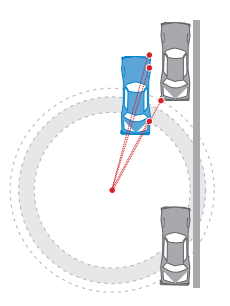
3. Check your blind spots. Look in your rearview mirror and over your shoulder for approaching vehicles and pedestrians.
4. Begin backing up. Turn your steering wheel to back into the space at about a 45-degree angle.
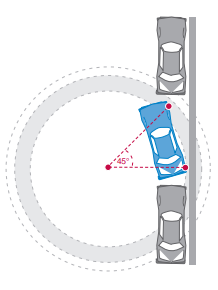
5. Straighten out. Begin turning the steering wheel away from the curb when your rear wheel is within 18 inches of the curb. You may need to pull forward and backward to straighten out. Your vehicle should now be parallel and within 18 inches of the curb.
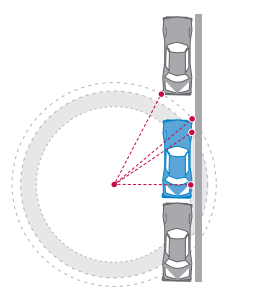
Turn off your vehicle and set the parking brake. Before you exit your vehicle, look carefully for passing vehicles, bicycles, and motorcycles. Exit when safe.
Straight Line Backing
To back up in a straight line:
- Traffic check. Observe traffic and check appropriate blind spots.
- Signal. Activate the turn signal before pulling up to the curb. Cancel the turn signal once completed.
- Check your blind spots. Look in your rearview mirror and over your shoulder for approaching vehicles and pedestrians.
- Begin backing up. Back in a straight line for three vehicle lengths while remaining within three feet of the curb. Stay aware of what is behind you when backing up.
- Control. To maintain control of the vehicle, back at a smooth, safe speed and adjust the steering wheel when needed. Practice until you can keep the vehicle straight. Repeat steps 1 and 2 to pull away from the curb.
Parking on a Hill
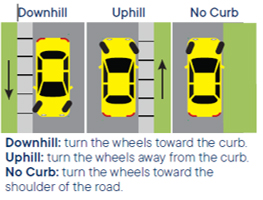
When you park on a hill, your vehicle could roll due to equipment failure. Remember to set the parking brake and leave the vehicle in park, or in gear for manual transmission. To park:
- On a sloping driveway: Turn the wheels so the vehicle will not roll into the street, leave the vehicle in park and set the parking brake.
- Headed downhill: Turn your front wheels into the curb or right toward the side of the road.
- Headed uphill: Turn your front wheels away from the curb (left-towards the center of the road) and let your vehicle roll back a few inches. The wheel should gently touch the curb.
- Headed either uphill or downhill when there is no curb: Turn the wheels to the right so the vehicle will roll away from the center of the road if the brakes fail.
Parking at Colored Curbs
Painted colored curbs have special parking rules.
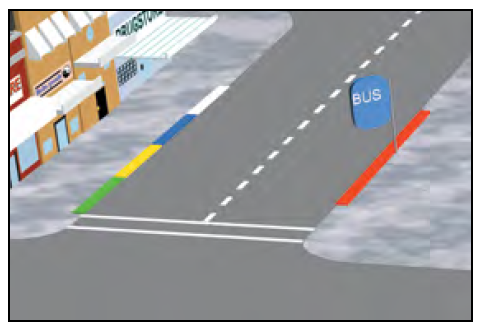
- White: Stop only long enough to pick up or drop off passengers.
- Green: Park for a limited time. The time limit may be posted on signs or painted on the curb.
- Yellow: Load and unload passengers and freight. Do not stop longer than the time posted. If you drive a noncommercial vehicle, you are usually required to stay with your vehicle.
- Red: No stopping, standing, or parking. Buses may stop at a red zone marked for buses only.
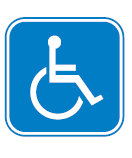
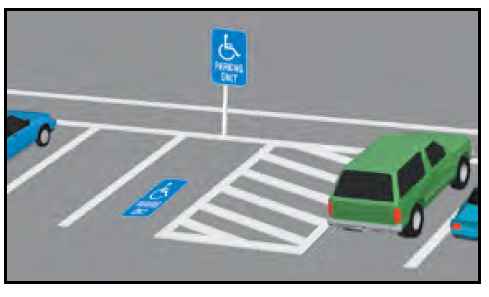
- Blue: Parking for a disabled person or someone driving a disabled person with a special placard or special license plate.
- To learn more about disabled parking placards and license plates, visit dmv.ca.gov/disabled-person-parking.
Illegal Parking
Never park or leave your vehicle:
- Where a NO PARKING sign is posted.
- On a marked or unmarked crosswalk.
- On a sidewalk, partially blocking a sidewalk, or in front of a driveway.
- Within three feet of a sidewalk ramp for disabled persons.
- In front of or on a curb that provides wheelchair access to a sidewalk.
- In the crosshatched (diagonal lines) area next to a designated disabled parking space.
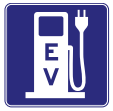
- In a space designated for parking or fueling zero-emission vehicles, unless you are driving a zero-emission vehicle.
- In a tunnel or on a bridge, unless permitted by signs.
- Within 15 feet of a fire hydrant or fire station driveway.
- Within 20 feet of an unmarked or marked crosswalk, or within 15 feet of a crosswalk where a curb extension is present.
- Between a safety zone and curb.
- Double parked.
- On the wrong side of the street or on a freeway, except:
- In an emergency.
- When a law enforcement officer requires a stop.
- Where a stop is specifically permitted.
If you must stop on a freeway, park completely off the pavement and stay in your vehicle with the doors locked until help arrives. A vehicle that is stopped, parked, or left standing on a freeway for more than four hours may be removed.
Electric Vehicles
Local authorities can reserve parking spaces on public streets for electric vehicle charging.
Driving Green
Maximize your fuel efficiency while helping to lower emissions by following these practices:
- Speed up and slow down smoothly. Drive at a steady speed.
- Regularly inflate your tires, get oil changes, and check filters.
- Get rid of extra weight in your vehicle.
For more information, visit fueleconomy.gov.
Law Enforcement Stops
During a Law Enforcement Stop
- Turn on your right turn signal to acknowledge that you see the officer.
- Move completely onto the right shoulder, even if in the carpool/HOV lane. Stop in a well-lit area when possible.
- Turn off your radio.
- Remain inside your vehicle unless directed to get out by the officer.
- Roll down your window after stopping your vehicle and before the officer makes contact with you.
- The driver and all passengers should place their hands in clear view before the officer makes contact with them.
Law enforcement officers must state the reason for a traffic or pedestrian stop before they begin any questioning related to a criminal investigation or traffic violation. An exception is made if an officer reasonably believes withholding the reason is necessary to protect life or property from imminent threat. The reason for the stop must be documented on the traffic citation also known as a traffic ticket issued or law enforcement report completed.
Your Rights During the Enforcement Stop
If an officer asks your permission to do something, you have a right to say no. However, if you say no and the officer says they are going to do it anyway, you do not have a right to interfere with their actions. For example, an officer may request to search part or all of your vehicle. You have a right to decline that request, but the officer may have the legal authority to search your vehicle under certain circumstances. If you do not want the officer to search your vehicle, you should clearly say that you do not give your permission, but you do not have a right to resist or obstruct the officer if they search your vehicle.
The driver of a stopped vehicle must produce a driver’s license, proof of insurance, and vehicle registration when stopped by law enforcement. If a driver does not produce these documents, officers may conduct a limited search for them. An officer may also request the names or identification of passengers. Passengers can decline that request, but under some circumstances the passengers may be required to identify themselves. If passengers do not want to produce their identification, they should clearly say so. Passengers should not interfere with the officer’s duties in conducting the traffic stop, and if an officer demands identification, passengers should not interfere with the officer’s actions. During a traffic stop, an officer can legally require the driver and all passengers to exit or stay inside the vehicle. If you are told to exit the vehicle or stay inside, you must do so.
In California, only federal law enforcement officers can ask you about your immigration status. California law prohibits state and local officers from asking drivers or passengers about their immigration status. If a California law enforcement officer asks you about your immigration status, you can decline to answer.
In general, the First Amendment protects the right of drivers and passengers to record interactions with law enforcement in public spaces. If you are recording, you should immediately make that clear. You do not have a right to interfere with the officer’s lawful duties during the enforcement stop, and you should not reach into concealed areas to retrieve your recording device without the officer’s permission. If your recording is not interfering with the officer’s ability to lawfully do their job, an officer cannot confiscate your recording device, delete the recording, or destroy the device just because you are using it to record. In general, you also have the right to deny a request to unlock a cellular phone or provide a password to it, though under some circumstances, such as if you are on parole, you may have to give permission in response to such requests. Finally, no government employee can retaliate against you just because you recorded something in public.
Even if you believe your rights were violated, you should not engage in physical resistance or violence against the officer. If an officer does something that you believe violates your rights, you can voice your objection, but you should not physically resist. Everyone has the right to be safe during a traffic stop. Your safety and the officer’s safety could be jeopardized if the situation escalates with physical resistance or violence. All members of the public have a right to file a complaint against any law enforcement agency, and it is against the law for any government employee to retaliate against you for doing so. You can file a complaint with the law enforcement agency that employs the officer. You have a right to be free from discrimination based on your actual or perceived race, sex, color, ethnicity, national origin, age, religion, gender identity or expression, sexual orientation, mental or physical disability, medical condition, or citizenship status. You also have other rights guaranteed by the United States and California Constitutions, as well as California and federal laws. When you file a complaint, the agency that employs the officer must investigate the complaint. Links to contact information for California law enforcement agencies can be found at post.ca.gov/le-agencies.