

15.140 Stolen or Embezzled OHVs (VC §38125)
Within 20 days after the date of recovery, the owner of a stolen or embezzled OHV vehicle may secure the identification or renewal of identification without penalty if the vehicle was not in their possession when penalties accrued.
A Stolen or Embezzled Vehicle Certification (REG 256A) form completed by the owner must be submitted with the application.
15.135 Special Manufacturer, Dealer, or Distributor Permit for OHV (VC §§38021, 38087, and 38231)
A special series OHV plate is issued for the purpose of display, delivery, or demonstration of an OHV owned or lawfully possessed by a manufacturer, dealer, or distributor of OHVs. The plate expires on June 30 of the second calendar year following the year of issuance.
The applicant must submit:
- An Application for Title or Registration (REG 343) (PDF) form completed as follows:
— Enter “dealer,” “distributor,” or “manufacturer” in the VIN field.
— Enter the name, address, and signature of the manufacturer, dealer, or distributor.
Note One REG 343 (PDF) may be used for several permits.
The procedures below must be followed:
- Collect an OHV fee for each permit. Refer to Appendix 1F for OHV fees.
Note If the special plate is lost, a substitute may be obtained by the applicant by submitting a request to DMV headquarters in writing with the substitute plate fee.
15.130 Specially Constructed OHVs
The requirements for a specially constructed (SPCNS) OHV, are the same as shown in Chapter 7 for other SPCNS vehicles, except:
- A Statement of Construction (REG 5036) (PDF) form is required.
Note A motor vehicle bond is required for the total value of the vehicle if the value of the parts not covered by bill(s) of sale is more than $5000.
- An electronic Vehicle Safety Systems Inspection (VSSI) certificate is not required.
- A smog certification is not required.
- Use tax is not due on a vehicle constructed/built by the applicant. Use tax is due if the vehicle was built by someone else and purchased as a complete vehicle by the applicant.
Note SPCNS OHVs must be referred to the California Highway Patrol (CHP) for assignment of a vehicle identification number (VIN).
15.125 Reregistration of Junk or Salvage Vehicle as an OHV (VC §38185)
The requirements for OHV registration of a junked or salvaged vehicle are the same as for regular on-highway registration except:
- An electronic Vehicle Safety Systems Inspection (VSSI) certificate is not required.
- A smog certification is not required.
15.120 Registration of Noncomplying OHV (VC §§4000, 38010, 38012, 38040, and 38070)
California Air Resources Board (CARB) regulations limit the use of OHV that do not meet emissions standards applicable for California OHV riding areas (non-complying OHV).
Issuance of Tan OHV Identification/Stickers
DMV will issue a tan sticker for noncomplying off-highway vehicles (OHVs) model year 2022 and newer. The new tan sticker will differentiate these vehicles from model year 2003 through 2021 vehicles (which were issued red stickers) and assist riding park management personnel with identification and law enforcement efforts.
Note Applications for noncomplying OHVs model year 2022 and newer will be finalized at DMV headquarters because the system is not programmed to issue the new tan sticker. DMV will continue to issue red stickers to noncomplying OHVs model year 2003 through 2021.
The procedures below must be followed:
Registration of Noncomplying OHVs
| If the OHV Is a | Then it |
|---|---|
| If the OHV Is a• 2002 or older year model OHV • Snowmobile • Amphibian • Dune buggy • Golf cart | Then itCan be registered and issued a green OHV sticker. |
| If the OHV Is a2003 through 2021year model with a “3” or “C” in the eighth vehicle identification number (VIN) position Note: Street-legal motorcycles with a “3” or “C” in the eighth VIN position may be registered if assigned the correct on-road type license code | Then itIs a noncomplying OHV and can be registered. Issue a red OHV sticker. Refer to the Registration of Noncomplying OHVs section for procedures. |
| If the OHV Is a2022 and newer year model OHV with a “3” or “C” in the eighth VIN position | Then itIs a noncomplying OHV and can be registered. Business Partner Automation (BPA) program participants utilizing the Virtual Clerk system should contact their First Line Service provider for guidance on indicia issuance. |
Note The title/registration for noncomplying OHV motorcycles and ATVs are branded “NC M/C” or “NC ATV.”
2003 and newer year model OHVs with a “3” or “C” in the eighth position of the vehicle identification number (VIN) are noncomplying OHVs and are issued a red OHV sticker that permits limited operation of the OHV during designated months (this includes Kazuma and Zebra brand OHVs).
- Noncomplying OHVs cannot be registered for on-highway use and do not qualify for dual registration (on-highway and off-highway).
- Ownership of a noncomplying OHV is transferable and the OHV registration is renewable every two years.
Exclusions—Always issue a green OHV sticker to:
- 2002 and older year model OHVs.
- Snowmobiles (SM).
- Amphibians (AP).
- Dune buggies (DB).
- Golf carts (GC).
Note The Motorcycle Transportation Permit (REG 712) is available for competition (racing) motorcycles. Refer to the Motorcycle Transportation Permit.
15.115 Planned Non-Operation Certification (REG 102) (VC §38121)
The owner of an OHV who does not wish to renew the registration must file a Planned Non-Operation Certification (REG 102) (PDF) form and pay the required planned non-operation (PNO) fee prior to the registration expiration date.
PNO is not required to be filed biennially.
15.110 Original OHV Registration Applications (VC §§4000, 24007, 38010, 38012, 38040, 38070, and 38080)
California Air Resources Board (CARB) regulations require 2003 and newer year model OHVs to have approved emissions systems in order to be issued a green (complying) sticker. To determine if the vehicle’s emission system is in compliance, or exempt from, California regulations, all 2003 and newer year model OHV must be verified.
New and Used OHVs Defined—New OHVs are vehicles that have not been previously registered or operated by a prior owner in another state before being purchased by a California resident. Used OHVs are vehicles that have been previously registered or operated by a prior owner in another state.
The following must be submitted:
- Proof of ownership. This may be any one of the following:
— An Application for Registration of New Vehicle (REG 397) form, if sold by a California dealer. The frame and engine numbers must be shown for motorcycles and all-terrain vehicles (ATVs).
— A completed Application for Title or Registration (REG 343) (PDF) form and nonresident requirements.
— The Manufacturer’s Certificate/Statement of Origin (MCO/MSO) endorsed to the nonlicensed dealer or the original or certified copy of the factory invoice to the nonlicensed dealer and any bills of sale needed to establish a complete chain of ownership to the applicant. A Statement of Facts (REG 256) (PDF) form may be accepted in lieu of a MCO/MSO or factory invoice for a vehicle valued at $5,000 or less, as shown on the REG 343 (PDF). A motor vehicle bond and REG 256 (PDF) are required if the vehicle is valued over $5,000 and proof of ownership cannot be furnished.
— A business invoice with the name and address of a California nondealer. - A completed Application for Title or Registration (REG 343) (PDF) form, if a REG 397 is not submitted.
- A Verification of Vehicle (REG 31) (PDF) form, unless a REG 397 is submitted.
- Fees due.
The procedures below must be followed:
- Determine if the OHV qualifies for issuance of a green sticker as follows:
| If the OHV Is a | Then the OHV |
|---|---|
| If the OHV Is a2002 or older year model vehicle | Then the OHVCan be registered and issued a green sticker. |
| If the OHV Is a2003 or newer year model vehicle with an emission label indicating compliance with California regulations for off-road vehicles or on-highway use | Then the OHVCan be registered and issued a green sticker. |
| If the OHV Is a2003 or newer year model vehicle with an emission label indicating it meets or complies with U.S. EPA standards only for on-highway use | Then the OHVCan be registered and issued a green sticker unless it is a California noncertified refusal as explained in the California Noncertified and Direct Import Vehicles Registration Refusals. |
| If the OHV Is a2003 or newer year model vehicle that does not have an emission label | Then the OHVCannot be registered and issued a green sticker unless: It was brought into California new or used by a nonresident and registered to that owner.The owner qualifies for an exemption, as explained in California Noncertified and Direct Import Vehicles Exemptions. |
| If the OHV Is a2003 or newer year model vehicle with a “3” or “C” in the eighth position of the vehicle identification number, Note: Street-legal motorcycles with a “3” or “C” in the eighth position may be registered if assigned the correct on-highway type license code | Then the OHVIs noncomplying and cannot be issued a green sticker. Refer to the Registration of Noncomplying OHVs section in this chapter for procedures. |
| If the OHV Is aVehicle sold new on or after January 1, 2008, which bears a small off-road engine (SORE) label | Then the OHVCannot be registered. The procedures below must be followed: Refuse the registration application. Copy the documents, and return the originals to the customer. Fax the copies to the Technical Compliance Section (TCS) at (916) 657-6763 with a Statement of Facts (REG 256) form stating, “Registration refused SORE label.” Refer to California Noncertified and Direct Import Vehicles Registration Refusals. |
- Collect the fees and use tax, if due. Refer to Appendix 1F.
— The motorcycle cross index fee is not due for OHV motorcycles.
— The nonresident service fee is not required for OHV registration.
For OHVR Processing
| If a/an | Then |
| Original application | The Vehicle Verifier must ask owner if the vehicle is a part of a fleet. – If not part of a fleet, the label is not required, complete REG 31 and go to step 2. – If the answer is yes, look for CARB’s vehicle emission control information (VECI) label. Note If a fleet vehicle does not have a CARB VECI label, inform the customer they must obtain the label from CARB. – Add “fleet” to the remarks section of the REG 31. Process following current procedures. |
| Renewal, with an incorrect sticker previously issued and vehicle license and title (VLT) stop on record | 1. Suspense the application to headquarters with: – Complete Application for Replacement Plates, Stickers, Documents (REG 156). – Complete Statement of Facts (REG 256). – A new Vehicle Verification (REG 31) must be completed: — The Vehicle Verifier must ask owner if the vehicle is a part of fleet. — If not a part of a fleet, the label is not required, complete REG 31 and go to step 2. — If the answer is yes, look for CARB’s Vehicle Emission Control Information (VECI) label. Note If a Fleet vehicle does not have a CARB VECI label, inform the customer they must obtain the label from CARB. Add “fleet” to the remarks section of the REG 31. 2. Process following current procedures. – Use the Electric Motor Number or the VIN in place of the engine number on the Inquiry Screen. – Ensure a Green OHV sticker is issued. 3. Collect the renewal fees, if due. |
| Renewal, with incorrect sticker previously issued and no stop on record | 1. Complete REG 156. 2. Complete REG 256. 3. A new REG 31 must be completed: – The Vehicle Verifier must ask owner if the vehicle is a part of fleet. – If not a part of a Fleet, the label is not required, complete REG 31 and go to step 4. – If the answer is yes, look for CARB’s VECI label. Note If a fleet vehicle does not have a CARB VECI label, inform the customer they must obtain the label from CARB. – Add “fleet” to the remarks section of the REG 31. 4. Process following current procedures. – Use the Electric Motor Number or the VIN in place of an engine number on the Inquiry Screen. – Ensure a Green OHV sticker is issued. Collect renewal fees, if due. |
Direct Import Motorcycles—A direct import is considered new if it enters California or is obtained by a California resident before it is two years old. The following applies when OHV registration is requested for a direct import motorcycle:
- A used direct import motorcycle (more than two years old) may be issued an OHV identification card only.
- A new direct import motorcycle, as defined above, cannot be registered.
- Direct import OHV registrations must be branded “Non-USA” and cannot be converted to street registration.
The procedures below must be followed:
- Copy the documents and give the originals back to the applicant.
- Not collect any fees.
- Not issue indicia.
- Attach the DMV file copy to the document copies and forward the application to the TCS MS E276 in DMV headquarters.
- Advise the applicant that DMV headquarters will review the documents and notify them of any additional requirements.
- Refer customers with questions or concerns regarding emission labels or emission standards to the California Air Resources Board (CARB) at 1-800-242-4450 or arb.ca.gov.
Abbreviations for Chinese Motorcycles and ATVs
The Department of Motor Vehicles Automation (DMVA) system does not currently generate any data for certain motorcycles and all-terrain vehicles (ATVs) because the vehicle identification numbers (VINs) are not supported by the system’s VIN decoder—VINtelligence.
When keying an original transaction and the VIN does not generate any data, key the information as shown on the Report of Sale.
Use the Make Abbreviations associated with the manufacturers listed below:
| Manufacturer | Make Abbreviation | Type |
|---|---|---|
| ManufacturerJiangsu Baodiao Locomotive Co., Ltd | Make AbbreviationBAODIAO | TypeMotorcycle |
| ManufacturerTaizhou Zhongneng Motorcycle Co., Ltd | Make AbbreviationZNEN | TypeMotorcycle |
| ManufacturerZhejiang Kayo Motor Company | Make AbbreviationKAYO | TypeATV |
| ManufacturerReytech Power Science & Technology | Make AbbreviationCRT | TypeATV |
15.105 Operation of an OHV on the Highway (VC §38025)
Motor vehicles identified as OHVs may be operated or driven upon a highway only as follows:
- On a two-lane highway only to cross the highway which is closed to motor vehicles subject to registration commencing with VC §4000.
- Only to cross at designated places on highways with more than two lanes.
- Towed (not driven) upon a highway, if it displays an OHV identification (ID) plate.
- Motorcycles may be pushed upon a highway if they have a valid OHV ID plate displayed upon them.
- Racing or competitive motorcycles displaying a Motorcycle Transportation Permit may be transported upon a highway to and from racing events on a closed course.
An OHV must have OHV ID, regular vehicle registration, or a Motorcycle Transportation Permit in order to be transported on the highway.
15.100 OHV Verification (VC §38041)
The following applies to OHV verifications:
- The Verification of Vehicle (REG 31) (PDF)form may only be completed by an authorized DMV employee for new and used off-highway motorcycles converting to on-highway or dual registration in order to verify the emission label and determine if the motorcycle can be converted to on-highway use. Refer to the OHV Motorcycle Verification information in the Conversion from OHV to On-Highway Registration section in this chapter.
- The REG 31 (PDF) for a motorcycle must include the engine and frame numbers.
- A clear pencil tracing of a snowmobile vehicle identification number (VIN) may be accepted in lieu of a physical verification (neither are required when an Application for Registration of New Vehicle (REG 397) form is submitted).
- A REG 31 (PDF) is not required when evidence of prior California registration or identification is submitted and there is a vehicle record on DMV’s database.
- A REG 31 (PDF) is required when there is not a record for the vehicle on the database (unavailable records).
- If a small off-road engine (SORE) label is found, on the REG 31 (PDF)check the “See Remarks” box in the Emission Label section and write “Small Off-Road Engine emission label” in the Remarks section. Refer to the Original OHV Registration Applications section in this chapter.
- Off-highway electric recreational vehicles (OHRVs) and off-highway eMotos do not require a federal emission label or a California Air Resources Board (CARB) label.
Follow the chart below to determine when an emission label is required:
OHRV Emission Label Requirements
| Type | Description | CARB Emission Label | FEDERAL EPA Label |
| Electric OHRV | – Off-Highway Motorcycle (eMoto) – All-terrain vehicles – Off-road utility vehicles – Off-road sport vehicles – Sand vehicles | Not required unless OHRV is a part of a “fleet”. | Not required |
On-Highway/Street Legal Electric Motorcycles (eMotos)Emission Label-Required
| Type | Descriptions | CARB Emission Label | Federal EPA Label |
| Zero Emission/Electric Street use motorcycles | *Motorcycles, less than 50 cubic centimeters (cc) displacement, with motor | Not Required | Required – U.S. EPA Vehicle Emission Control Information (VECI) |
| Street use Gas Powered Motorcycles | *Street-use Motorcycles, less than 50 Cubic centimeters (cc) displacement, with engine * | Not Required | Required – U.S. EPA Vehicle Emission Control Information (VECI) * |
Note Authorized Vehicle Verifiers must check both check boxes for “Vehicle meets US EPA standard only” and “Engine displacement less than 50cc (cubic centimeters) when completing a REG 31.
Electric Motorcycles (eMotos) – Typical Locations
- On the motor housing or mounting plate — manufacturers often place it on a flat metal surface of the motor or its mounting bracket, stamped or engraved on the side or top of the motor.
- Between the battery and the motor — on some models, it’s stamped or engraved on the motor housing or a nearby metal plate.
- On the side of the bulkhead — in some cases, it’s visible from the outside between the battery and motor, or on the frame side where the motor mounts, but may be partially obscured by paint or components.
Note: Shine a flashlight at an angle across the surface to make the stamping more visible.
Electric Off‑Highway Vehicle (OHV) Typical Locations
On an electric OHV, the engine number is not a traditional internal combustion engine number; instead, it refers to the motor number or electric motor serial number. This is a unique identifier for the vehicle’s electric drive system, used for registration and service tracking.
- Stamped on the motor itself — most manufacturers place the motor number directly on the motor housing or mounting plate. For example, Kia’s electric vehicles have the motor number stamped on the motor.
- On a label attached to the vehicle — some electric OHVs have a certification or service label on the chassis, frame, or near the battery/electrical assembly that includes the motor number.
- On the chassis or frame — in some cases, the motor number is engraved or stamped on the front or driver’s side frame near the motor mounting area.
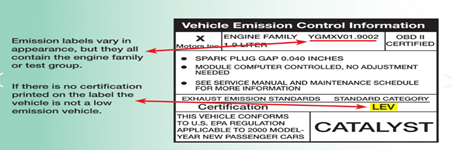
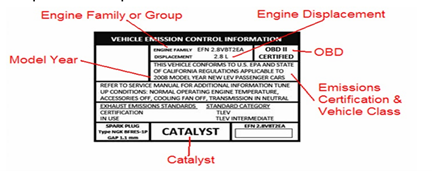
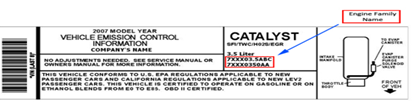
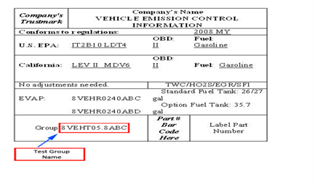
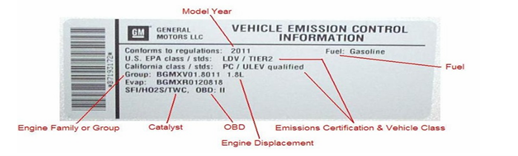
Samples of Vehicle Emission Control Labels:
U.S. EPA Vehicle Emission Control Information label (VECI) and Standard Category should have LEV or ZEV Under ‘Standard Category.
15.095 OHV Motorcycle Engine Changes (VC §4161)
When the engine number of an off-highway motorcycle has been recorded on DMV’s records and the owner later reports an engine change, process in accordance with the VIN and/or Engine Changes.
Note If the vehicle is registered for both on-highway and off-highway use, pick up the OHV identification card and the on-highway certificates, line out the old engine number, and write the new engine number above the lined out number.